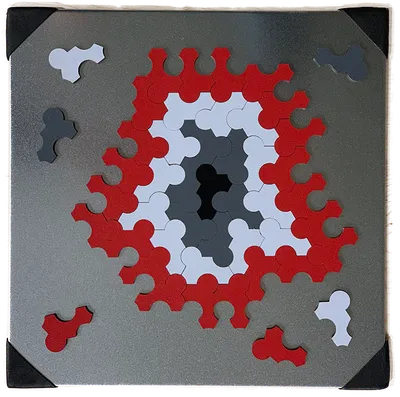
Try to tesselate with Corona Tiles
We were recently introduced to an interesting area of tiling research by mathematician Colin Adams. This is a story about tiles that can fill the plane, tiles that clearly can’t, and tiles that occupy a role in between those two extremes. First, some background…
You don’t often see floor tiled with circular tiles. That is because if you tile with circles, you must have substantial spaces between the tiles. We can only pack them together as close as possible. Mathematicians call this apacking.
A tiling of the plane without any gaps is atesselation. If you have a finite set of tile shapes that tesselates, it may be possible to tesselate the plane with them. The simplest case is a single tile shape. A square tesselates…
and in fact, any quadrilateral will tesselate.
A regular pentagon, on the other hand, does not tesselate, as illustrated here by Johannes Kepler.
But there are 15 types of pentagons which do tesselate. The 15th type was discovered in 2015 by Casey Mann and others. Here is one of the tiles.
You might wonder how you would tile the plane with an irregular shape like that. You might even conclude it isn’t possible, if we had not already told you it is possible. A solution in this case is to assemble 6 of the tiles into a patch…
which then tiles the plane…
In 2017, Michaël Rao showed there are only 15 pentagonal shapes that tile the plane.
Colin Adams pointed us to tiles that appear they may tesselate, but after some progress in tiling without gaps, we get stuck. Heinrich Heesch was the first to take interest in such tiles. In 1968, Heesch gave an example. He combined a square, an equilateral triangle, and a 30-60-90 triangle
to create an ir regular pentagon
Starting with the black tile in the center, you can tile all the way around the black tile without gaps.
The tiles that go around the center form acorona. However, you cannot create another corona around these tiles. Heesch suggested assigning the number 1 to this tile shape, indicating you could create only one corona.
Others became interested. There are tiles with Heesch number 2, 3, 4, and 5. Casey Mann, one of the researchers who discovered the last pentagon tile, discovered the tile with Heesch number 5. He also discovered a tile that became our favorite for playing with. It has Heesch number 3.
Starting with this single tile, you can create a corona 3 times before you get stuck. In fact, getting the third corona is not easy! If you want to see how, you can watch this video…
Of course, you can also just have fun playing the with the negative spaces:
Want to learn more?
Order Corona tiles from our online store, and have fun trying to find three coronas, or create your own designs with negative spaces!
Watch the excellent Heesch numbers and Tiling with Brady and Edmund Harris
Read about Heesch’s problem on Wikipedia
For a deep dive, read Casey Mann’s article Heesch’s Tiling Problem