Stuck on Socolar–Taylor Tiles
A set of tile shapes is aperiodic if, no matter how you try, the tiles refuse to allow a wallpaper like pattern of repetition. The first known set of aperiodic tiles appeared in the 1960s, and used over 20,000 different tile shapes. To our knowledge, nobody ever made those tiles. Ideally, a set of tiles requires very few distinct shapes. Roger Penrose discovered tile sets that only required two shapes (see P2 and P3), as did amateur mathematician Robert Ammann(see the Golden B and Ammann-Beenker).
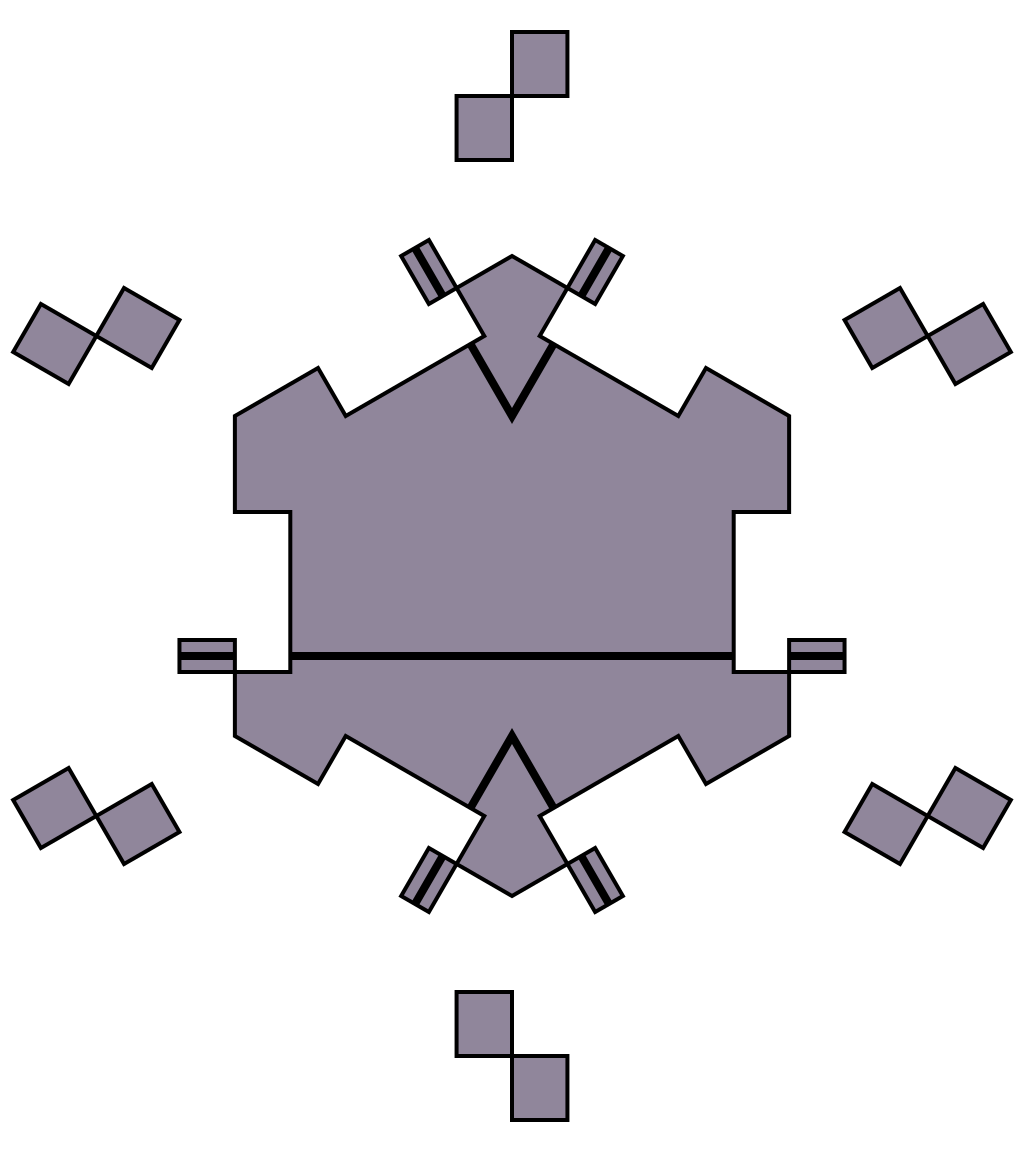
Is there a single tile that only tiles aperiodically? Joan Taylor, an amateur mathematician from Tasmania, and Joshua Socolar provide an answer: a qualified yes. Visually, their tile is fragmented. Think of the fragments as part of a disconnected whole.
You cannot create such a tile: you need the fragments to magically maintain their relative position as you move the piece! So we simulate the tile with a simple hexagon that has markings, and impose some rules.
The Rules
Where edges meet, dark lines must touch.
Triangles at opposite ends of a tile edge must point in the same direction.
Look at the rule illustration below. The arrows point to the triangles at opposite ends of a tile edge. And those triangles point in the same direction:
Here the orange triangles violate the second rule:
Dead ends
With only a single tile, you might imagine that putting the Socolar–Taylor tiles together is straightforward. Socolar and Taylor provide substitution rules that allow you to start small, and then tear down and build up successively larger patches of tiles. But as something to explore and puzzle over, we like to put it together one piece at a time, looking for structures and (non-wallpaper) patterns. Despite having just one tile, it is a challenge to follow the rules. You may not easily visually recognize what to do next, and in fact, you might not be able to do anything! In the example below, it is not possible to place a tile in the empty spot, and so we are at a dead end. This means you need to change your tiling in order to continue.
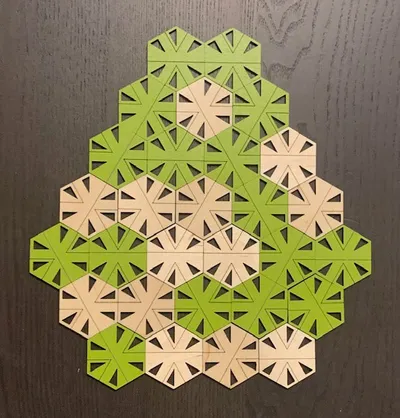
As you build up your tiling, triangular patterns miraculously emerge from the lines on the tiles, reminiscent of Sierpinski triangles. In the photo below, you can see that we clear–coated the reverse side of the tiles so that you can recognize patterns in the flipped tiles.
You can find them in our online store.
Images